
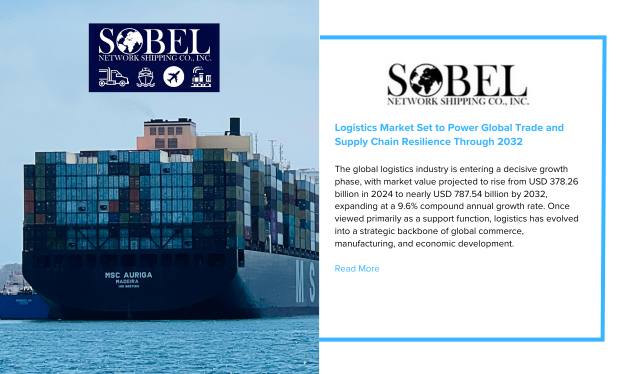
The global logistics industry is entering a decisive growth phase, with market value projected to rise from USD 378.26 billion in 2024 to nearly USD 787.54 billion by 2032, expanding at a 9.6% compound annual growth rate. Once viewed primarily as a support function, logistics has evolved into a strategic backbone of global commerce, manufacturing, and economic development.
As cross-border trade intensifies, e-commerce volumes surge, and customer expectations for speed and reliability continue to rise, logistics providers are redefining how goods move across the world. The sector now encompasses far more than transportation—integrating advanced technology, intelligent warehousing, data-driven decision-making, and last-mile innovation.
A Market Reshaped by Technology and Global Demand
Several forces are accelerating the transformation of logistics. Globalized supply chains and rising manufacturing output are increasing demand for freight forwarding, warehousing, cold chain services, and multimodal transport solutions. At the same time, digital technologies are reshaping operations end to end.
Artificial intelligence, IoT, automation, robotics, and advanced analytics are improving shipment visibility, reducing inefficiencies, optimizing routes, and increasing delivery accuracy. Smart logistics hubs, automated distribution centers, and emerging autonomous transport models are setting new performance benchmarks. Sustainability is also becoming central to logistics strategies, with investments flowing into electric fleets, energy-efficient facilities, and emissions reduction initiatives.
Despite this momentum, the industry continues to navigate challenges linked to geopolitical tensions, trade regulation complexity, rising operating costs, and infrastructure constraints—making resilience and adaptability critical competitive advantages.
Key Growth Drivers
The expansion of e-commerce remains one of the strongest catalysts, driving demand for last-mile delivery, fulfillment centers, and reverse logistics. Global trade integration continues to boost cross-border logistics activity, while ongoing infrastructure investment—spanning ports, highways, rail networks, and airports—supports faster and more reliable freight movement.
Equally important is the growing reliance on third-party logistics (3PL) and fourth-party logistics (4PL) models, allowing businesses to improve efficiency, reduce costs, and scale operations without heavy capital investment.
Emerging Opportunities Across the Sector
Significant opportunities are emerging across multiple segments. Last-mile delivery innovation—through electric vehicles, drones, and micro-fulfillment centers—is gaining traction. Cold chain logistics is expanding rapidly, fueled by demand from pharmaceuticals, food, and biotechnology. Automation and smart warehousing solutions are improving throughput and inventory accuracy, while logistics-as-a-service models are reshaping how companies outsource supply chain operations.
Sustainable logistics practices are also unlocking long-term value, as organizations seek to meet environmental targets while maintaining performance and profitability.
Regional Growth Outlook
North America remains a leading logistics market, supported by advanced infrastructure, strong e-commerce adoption, and early integration of automation technologies. Europe benefits from dense transport networks, cross-border trade efficiency, and sustainability-driven logistics initiatives. Asia-Pacific stands out as the fastest-growing region, driven by manufacturing expansion, export activity, and digital commerce growth. Meanwhile, the Middle East, Africa, and Latin America are strengthening their positions through port modernization, logistics corridors, and trade facilitation efforts.
The Road Ahead
As global supply chains grow more complex and interconnected, logistics will continue to play a central role in enabling trade, ensuring resilience, and supporting economic growth. Companies that invest in technology, sustainability, and operational agility will be best positioned to lead the industry through its next phase of transformation.
The logistics market’s trajectory through 2032 reflects not only rising demand, but a fundamental shift toward smarter, faster, and more resilient supply chain ecosystems worldwide.